BARRISTER
Aarif Abraham is a barrister specialising in public international law, international criminal law, arbitration, and conflict resolution. His practice focuses on some of the most complex questions of state responsibility, human rights, and accountability for mass atrocity crimes, including genocide, war crimes, and crimes against humanity.
He has acted in matters before international and hybrid courts and tribunals, provided counsel in disputes involving authoritarian regimes, and advised governments, public bodies, and international organisations on rule-of-law reform, constitutional questions, and transitional justice processes.
Mr. Abraham has held senior legal and investigative roles across private practice, international courts, NGOs, and multilateral institutions. His work is grounded in rigorous legal analysis and a commitment to strengthening lawful governance, justice mechanisms, and peaceful dispute resolution globally.
Current:
Consultant, United Nations;
Trustee, Coalition for Genocide Response;
Expert, Justice for Ukraine;
Adviser, Special Tribunal for Crime of Aggression;
Associate, Manchester International Law Centre;
Co-Founder, Yazidi Justice Committee.
2023
Accountability Unit
2021
2025
Past:
Legal Counsel, Uyghur Tribunal;
United Nations International Criminal Tribunal for Former Yugoslavia;
Court of Appeal of England and Wales;
among others.
Attorney General’s Public
International Law Panel of Counsel
2025
Aarif Abraham is an accomplished writer whose work examines the intersection of law, governance, international crimes, and democracy. His research and commentary address questions of how societies can prevent atrocities, uphold the rule of law, and build durable peace in fragile political environments.
He is the author of A Constitution of the People and How to Achieve It, a book exploring how citizens can meaningfully shape the political systems that govern them. His writing has been featured in respected outlets across law, foreign policy, and public affairs, where he analyses issues such as state accountability, constitutional design, foreign policy decision-making, and the global justice architecture.
Through his publications, Mr. Abraham aims to make complex legal ideas accessible and to contribute to informed public debate on some of the defining challenges of our time.
WRITER
Book reviews
❝ Abraham offers no prescription on the content of a constitutional settlement but a road map as to how it may be achieved. As such, he succeeds in inviting us to think about our individual and collective roles in constitution-making. ❞
Prof. Philippe Sands KC
A book about how people can have a greater say in how they are governed.
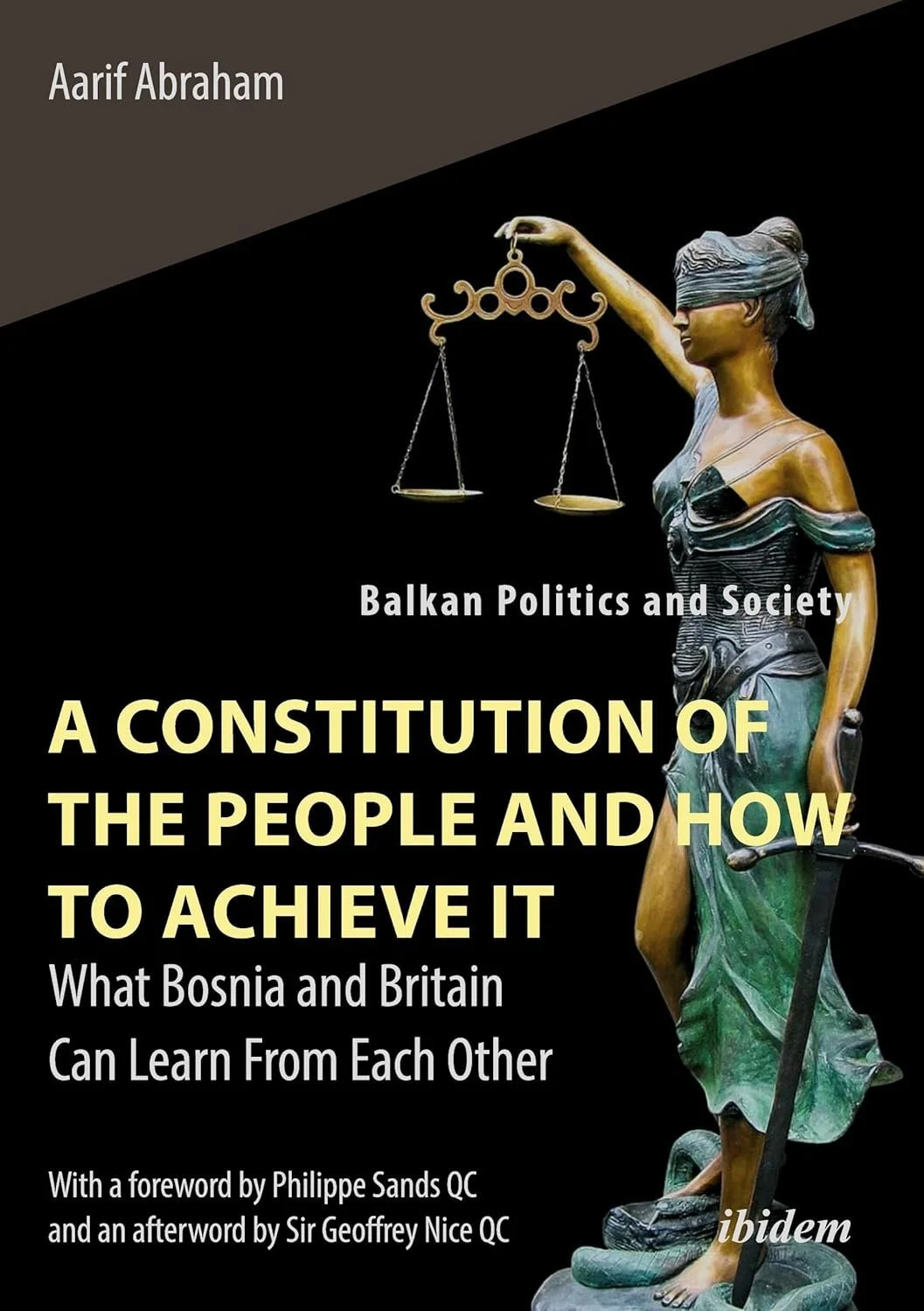
A Constitution of the People and How to Achieve It
What Bosnia and Britain Can Learn From Each Other
About the Book
Britain does not have a written constitution. It has rather, over centuries, developed a set of miscellaneous conventions, rules, and norms that govern political behavior. By contrast, Bosnia’s constitution was written, quite literally, overnight in a military hanger in Dayton, USA, to conclude a devastating war. By most standards it does not work and is seen to have merely frozen a conflict and all development with it.
What might these seemingly unrelated countries be able to teach each other? Britain, racked by recent crises from Brexit to national separatism, may be able to avert long-term political conflict by understanding the pitfalls of writing rigid constitutional rules without popular participation or the cultivation of good political culture.
Bosnia, in turn, may be able to thaw its frozen conflict by subjecting parts of its written constitution to amendment, with civic involvement, on a fixed and regular basis; a “revolving constitution” to replicate some of that flexibility inherent in the British system. A book not just about Bosnia and Britain; a standard may be set for other plural, multi-ethnic polities to follow.
ORDER THE BOOK
Book reviews
❝ Abraham offers no prescription on the content of a constitutional settlement but a road map as to how it may be achieved. As such, he succeeds in inviting us to think about our individual and collective roles in constitution-making. ❞
Prof. Philippe Sands KC
A book about how people can have a greater say in how they are governed.
A Constitution of the People and How to Achieve It
What Bosnia and Britain Can Learn From Each Other
About the Book
Britain does not have a written constitution. It has rather, over centuries, developed a set of miscellaneous conventions, rules, and norms that govern political behavior. By contrast, Bosnia’s constitution was written, quite literally, overnight in a military hanger in Dayton, USA, to conclude a devastating war. By most standards it does not work and is seen to have merely frozen a conflict and all development with it.
What might these seemingly unrelated countries be able to teach each other? Britain, racked by recent crises from Brexit to national separatism, may be able to avert long-term political conflict by understanding the pitfalls of writing rigid constitutional rules without popular participation or the cultivation of good political culture.
Bosnia, in turn, may be able to thaw its frozen conflict by subjecting parts of its written constitution to amendment, with civic involvement, on a fixed and regular basis; a “revolving constitution” to replicate some of that flexibility inherent in the British system. A book not just about Bosnia and Britain; a standard may be set for other plural, multi-ethnic polities to follow.
ORDER THE BOOK
SPEAKER
A sought-after speaker, Aarif Abraham delivers engaging and incisive talks on international law, mass atrocity prevention, governance, human rights, and foreign policy. He regularly presents to governments, academic institutions, think tanks, civil society organisations, and international bodies.
Drawing on his experience across multiple jurisdictions and legal systems, he provides clear, evidence-based insights into how states and institutions can strengthen justice mechanisms, uphold democratic norms, and respond to emerging global risks.
Mr. Abraham’s presentations combine legal expertise with strategic analysis, offering audiences practical guidance on navigating complex international challenges—whether in policy design, institutional reform, conflict settings, or global governance.
NEWS
Subscribe
Substack





News
Publications in press
Ukraine marks major milestone in establishing Special Tribunal for the Crime of Aggression
Doughty Street Chambers · 5 Feb 2025
Ukraine achieves a significant breakthrough on the path toward establishing a Special Tribunal for the Crime of Aggression — an essential step in securing accountability for Russia’s leadership.
Preventative measures: UK support for a democratic and peaceful Bosnia
PoliticsHome · 17 October 2025
A commentary on how proactive UK engagement can reduce instability in Bosnia, strengthen democratic institutions, and counter malign political influences.
Lithuania refers Belarus to the International Criminal Court, alleging crimes against humanity
Doughty Street Chambers · 01 October 24
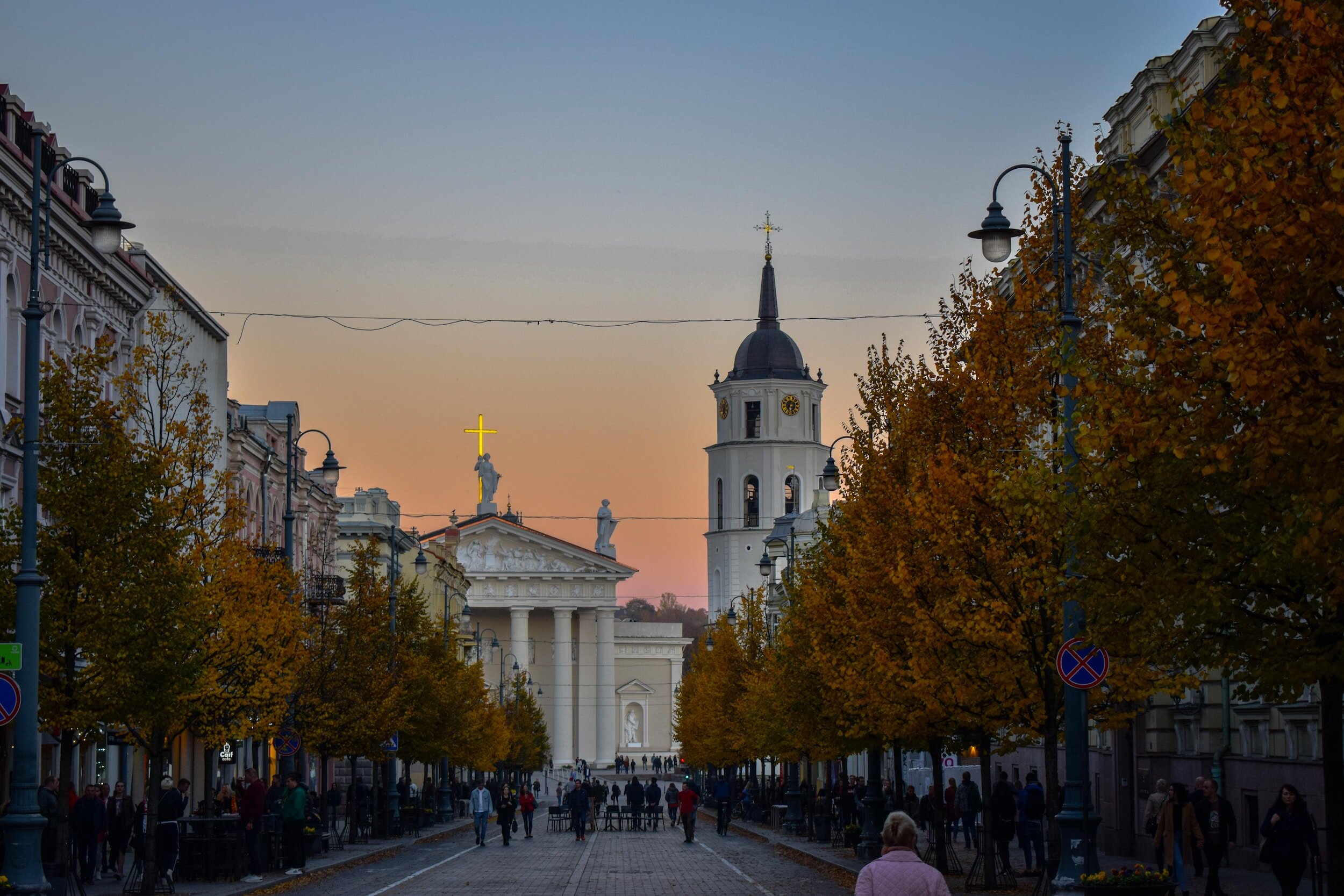
On 30 September 2024, the Government of the Republic of Lithuania, pursuant to Articles 13(a) and 14 of the Rome Statute, referred to the International Criminal Court (ICC) the situation in the Republic of Belarus, for investigation by the Office of the Prosecutor of the Court.
There ought to be no hiding place for Putin
Politico · 31 March 2023
Successful charges before an international tribunal would fully recognize the crime allegedly being committed by its full and proper name — the crime of aggression.
NEWS
Subscribe
Substack
News
Publications in press
Ukraine marks major milestone in establishing Special Tribunal for the Crime of Aggression
Doughty Street Chambers · 5 Feb 2025
Ukraine achieves a significant breakthrough on the path toward establishing a Special Tribunal for the Crime of Aggression — an essential step in securing accountability for Russia’s leadership.
Preventative measures: UK support for a democratic and peaceful Bosnia
PoliticsHome · 17 October 2025
A commentary on how proactive UK engagement can reduce instability in Bosnia, strengthen democratic institutions, and counter malign political influences.
Lithuania refers Belarus to the International Criminal Court, alleging crimes against humanity
Doughty Street Chambers · 01 October 24
On 30 September 2024, the Government of the Republic of Lithuania, pursuant to Articles 13(a) and 14 of the Rome Statute, referred to the International Criminal Court (ICC) the situation in the Republic of Belarus, for investigation by the Office of the Prosecutor of the Court.
There ought to be no hiding place for Putin
Politico · 31 March 2023
Successful charges before an international tribunal would fully recognize the crime allegedly being committed by its full and proper name — the crime of aggression.